
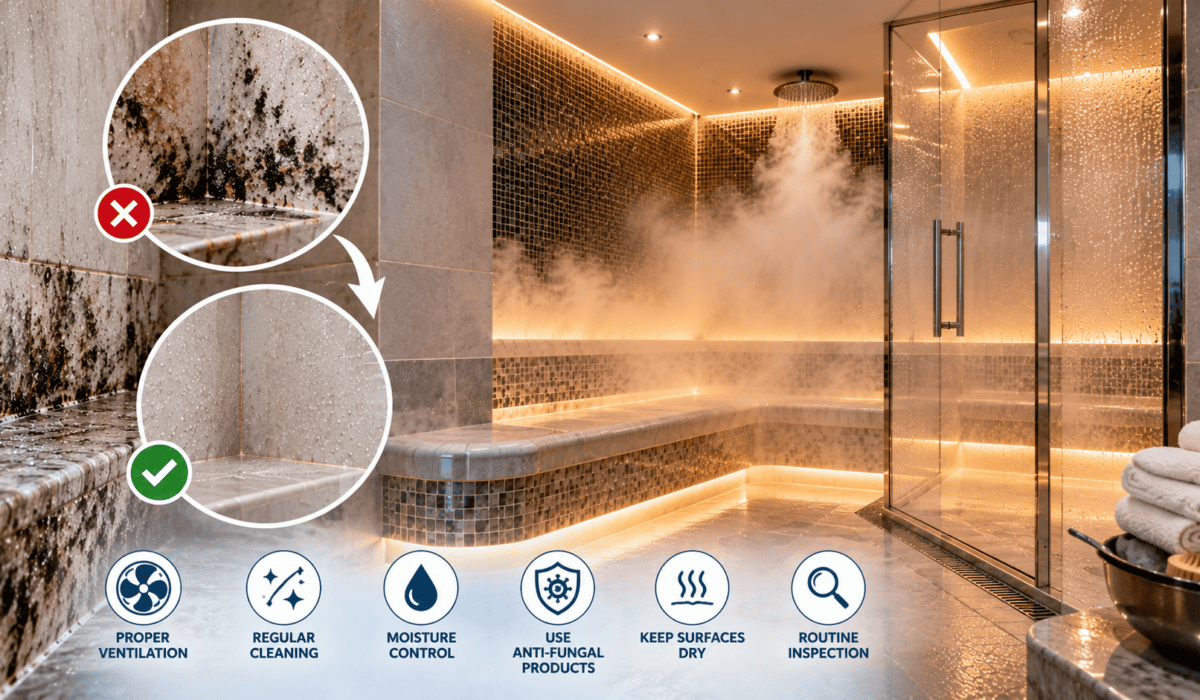
Steam Room Mold and Mildew Prevention: The Complete UAE Guide
Steam Room Mold and Mildew Prevention: The Complete UAE Hotel, Gym and Spa Guide
A steam room’s operating environment — 100% relative humidity, 40–50°C surface temperatures, near-constant moisture — is the perfect incubator for mold and mildew. In the UAE, where ambient heat and humidity already stress building envelopes and mechanical systems, steam rooms that are not managed with a rigorous prevention programme develop visible mold growth within weeks. This guide covers every element of effective steam room mold and mildew prevention: ventilation engineering, daily cleaning protocols, the right products, materials selection, and the Dubai Municipality and DHA compliance standards that apply to UAE wellness facilities in 2026.
Steam room mold and mildew prevention requires four measures working together: (1) post-session ventilation — run the extraction fan for a minimum of 30 minutes after every session to reduce surface moisture; (2) daily cleaning — wipe all surfaces with a pH-neutral anti-fungal solution and squeegee walls and benches while still warm; (3) weekly deep clean — apply a chlorine-free anti-mold treatment to grout lines, silicone joints and the ceiling, which are the highest-risk surfaces; and (4) correct material specification — ensure all sealants, grouts and silicone are rated for continuous wet-area and anti-fungal use. In UAE hotel and spa steam rooms, these four measures must be applied daily without exception. A single day of missed post-session ventilation or cleaning can initiate mold colonisation in a UAE steam room within 24–48 hours during summer months.
Why Steam Room Mold and Mildew Prevention Is Harder in UAE Than Anywhere Else
Mold and mildew are fungi that thrive wherever three conditions coexist: moisture, warmth and an organic substrate (grout, sealant, biofilm residue from guests). A steam room provides all three in abundance — but in the UAE, the problem is compounded by external climate factors that push spore loads and ambient humidity far above levels in temperate countries.
In a European steam room, ambient air drawn in for ventilation typically has 40–60% relative humidity — it is genuinely drying. In Dubai’s summer months, outdoor air at 80–90% RH barely dries a steam room surface at all, meaning post-session ventilation must work harder and run longer to achieve the same surface drying effect. This is the fundamental reason steam room mold and mildew prevention in UAE demands daily discipline and correctly specified ventilation systems — not the seasonal maintenance approach that may suffice in cooler climates.
UAE Summer Ventilation Air Is Already Near-Saturated — Extraction Alone Is Not Enough
During June–September in Dubai and Abu Dhabi, outdoor air at 80–90% RH delivers very little drying capacity when drawn into a steam room for post-session ventilation. In these months, supplement extraction ventilation with a dehumidifier rated for wet-room use, or extend post-session fan run-on time to a minimum of 60 minutes. Facilities that ventilate for only 20–30 minutes in summer months will find surfaces remain damp long enough to support mold initiation. This is the single most common cause of recurring mold in UAE hotel and hotel apartment steam rooms.
The Six Highest-Risk Mold Zones in a UAE Steam Room — Ranked by Risk Level
Ceiling and Upper Walls
Condensation collects on the ceiling continuously during operation. Heat rises, meaning mold spores concentrate near the top of the room. The ceiling is the first surface to develop visible mold in any steam room and the hardest to clean thoroughly. In UAE hotel steam rooms, ceiling mold is the most common compliance failure found during Dubai Municipality inspections.
Grout Lines
Standard cement-based grout is porous — it absorbs moisture and organic residue (body oils, soap scum, dead skin cells) that feeds mold colonies. Grout lines are impossible to dry completely with standard cleaning tools. Mold that takes hold in grout penetrates below the surface and is extremely difficult to eradicate without re-grouting.
Silicone Sealant Joints
Silicone sealant at wall-to-floor junctions, bench edges, and around the steam inlet nozzle is the fastest surface to develop black mold in a steam room. Standard construction silicone is not anti-fungal. Without anti-fungal-rated silicone, joints typically develop visible black mold within 3–6 months of installation in UAE’s climate, even with good cleaning practices.
Under and Behind Benches
The underside of benches and the wall area immediately behind them receives condensation but almost no cleaning contact. Poor air circulation in these areas creates a persistently damp microenvironment. Operators who clean bench surfaces daily but not undersides and back walls will find mold developing in these hidden zones within weeks.
Steam Outlet Nozzle and Surround
The area immediately around the steam outlet nozzle is continuously wet and mineral-rich (from steam condensate). Mineral deposits from UAE hard water provide an additional substrate for mold colonisation. The nozzle surround should be cleaned and descaled as part of every daily cleaning cycle.
Door Frame, Gasket and Threshold
The door gasket accumulates moisture and body residue at every session. The door frame threshold is a drainage transition point where water pools. These areas are often overlooked in quick daily cleans but develop mildew and biofilm relatively quickly without dedicated cleaning attention.
Ventilation: The Most Important Factor in Steam Room Mold and Mildew Prevention
No cleaning programme — however rigorous — can compensate for inadequate ventilation. A steam room that is not properly ventilated after each session will develop mold regardless of the products used. Ventilation removes the moisture from surfaces and lowers the relative humidity inside the room to a level at which mold cannot survive. Get the ventilation right first; cleaning maintains what ventilation enables.
Steam Room Mold Prevention: Daily, Weekly and Monthly Cleaning Schedule for UAE Facilities
Post the Cleaning Schedule Inside the Maintenance Room — Not Just in a Digital System
The most common reason UAE hotel and spa steam rooms develop mold is not a lack of a cleaning protocol — it is inconsistent execution. Cleaning staff change, shifts overlap, and digital task systems are missed. Post a laminated cleaning schedule inside the equipment room adjacent to the steam room, with a paper sign-off log. Physical logs are also easier to present to Dubai Municipality or DHA inspectors during compliance audits. Assign one named staff member as accountable for each daily session close-out, not just the team on shift.
The Best Anti-Mold and Mildew Products for UAE Steam Rooms — What to Use and What to Avoid
pH-Neutral Anti-Fungal Daily Cleaner
For daily surface cleaning of tiles, marble and stone — safe for all steam room surfaces including natural stone. Must be specifically formulated for wet-room use and contain an anti-fungal agent (quaternary ammonium compound or hydrogen peroxide-based). Avoid acidic or alkaline daily cleaners on natural stone — they etch the surface and create micro-abrasions that harbour mold.
Daily use · All surfacesAnti-Mold Grout Cleaner (Chlorine-Free)
Chlorine bleach is effective on grout mold but damages coloured grout, corrodes metal fittings and produces harmful fumes in an enclosed space. Use a chlorine-free anti-mold grout cleaner — oxygen-based or enzyme-based formulations are effective on embedded mold in grout lines without surface damage. Apply weekly to all grout lines; leave for 15 minutes before scrubbing.
Weekly · Grout linesAnti-Fungal Silicone Sealant
Not a cleaning product but a specification requirement — all silicone joints in a UAE steam room must be an anti-fungal rated product (look for “mold resistant” or “contains biocide” on the packaging). Standard construction silicone will develop black mold within months in UAE conditions. Anti-fungal silicone should be replaced at the first sign of persistent black discolouration — no cleaning product will eradicate mold that has penetrated silicone internally.
Specification · All jointsEpoxy Grout (New Installations and Re-Grouting)
For new steam room installations or re-grouting projects, specify 100% epoxy grout rather than cement-based grout. Epoxy grout is non-porous, waterproof and inherently mold-resistant — it does not absorb moisture or organic material. It is harder to apply than cement grout and costs more, but the reduction in ongoing mold maintenance in UAE conditions makes it strongly cost-effective over the life of the installation.
New install · Re-groutCitric Acid Descaler (Steam Nozzle and Fittings)
For descaling the steam outlet nozzle and metal fittings where UAE hard water mineral deposits accumulate. Mineral scale provides a surface substrate for mold colonisation — keeping fittings scale-free reduces mold risk on these components. Use citric acid solution (10%) weekly on the nozzle; do not use acid products on natural stone or grout.
Weekly · Fittings onlyEnzyme-Based Drain Treatment
Weekly application of a biological enzyme drain treatment breaks down the biofilm and organic residue that accumulates in steam room drains and drain lines — a primary mold initiation point. Enzyme treatments are non-corrosive, safe for all pipe materials and produce no harmful fumes. They should be poured into the drain at the end of the last cleaning session of the day so they have overnight dwell time.
Weekly · Drain and trapDo Not Use Chlorine Bleach on Steam Room Surfaces in UAE Hotel and Spa Environments
Chlorine bleach (sodium hypochlorite) is frequently used in UAE hotel maintenance for rapid mold remediation. In steam rooms, it is contra-indicated: the residual chlorine vaporises when the steam generator next operates, producing chlorine gas in the steam room — a respiratory hazard for guests. Bleach also corrodes stainless steel fittings, degrades grout colourant and etches unprotected natural stone. Use chlorine-free anti-mold products in steam rooms. If bleach has been used and the steam room is about to be returned to service, ventilate for a minimum of 4 hours and rinse all surfaces thoroughly before allowing guests to use the facility.
Materials That Prevent Steam Room Mold by Design — UAE Specification Guide
The single most cost-effective time to prevent steam room mold and mildew in UAE is at the design and specification stage. The right materials dramatically reduce ongoing maintenance burden — the wrong materials make adequate mold prevention nearly impossible regardless of cleaning intensity.
| Element | Avoid (High Mold Risk) | Specify (Low Mold Risk) | UAE Notes |
|---|---|---|---|
| Grout | Cement-based (porous — absorbs moisture and organics) | 100% epoxy grout (non-porous, waterproof, mold-resistant) | Epoxy grout is strongly recommended for UAE climate — the maintenance cost saving justifies the higher install cost |
| Sealant joints | Standard construction silicone (no anti-fungal additive) | Anti-fungal rated silicone (biocide-containing, wet-area grade) | Check product datasheet for “mold resistant” classification — not all “bathroom silicone” products contain biocide |
| Wall and floor tiles | Large format tiles with minimal grout (fewer joints, but if grouted with cement = risk) | Large format vitrified porcelain (near-zero water absorption) with epoxy grout | Avoid porous natural stone (travertine, limestone) in UAE steam rooms — extremely difficult to keep mold-free without constant sealing |
| Bench material | Porous stone without sealed underside; unsealed timber | Fully sealed marble or vitrified porcelain; marine-grade teak with adequate drainage gap underneath | Bench underside sealing is as important as the top surface — unsealed stone undersides absorb moisture and develop mold that migrates to the top surface |
| Ceiling | Plasterboard (even moisture-resistant grade) — absorbs condensate | Fully tiled ceiling (vitrified porcelain or ceramic) or stainless-steel coffered ceiling | A tiled ceiling is the standard in UAE hotel steam rooms — it is the only finish that withstands UAE steam room condensation without deterioration |
| Door and frame | Timber frame or aluminium frame without thermal break | Fully glazed frameless door with stainless steel hardware; or aluminium frame with thermal break and continuous anti-fungal silicone gasket | Door gasket must be anti-fungal rated silicone — replace at first sign of persistent discolouration rather than attempting to clean it back to white |
Steam Generator Drain and Floor Drain Management — An Overlooked Mold Source
The steam room floor drain and the steam generator’s own drain and blowdown line are primary mold initiation points that many UAE facility maintenance teams overlook. Both accumulate a warm, continuously moist biofilm of organic material — the ideal mold substrate — and both are connected to the room environment.
Dubai Municipality and DHA Steam Room Hygiene Requirements — UAE Compliance 2026
| Authority | Requirement | Applies To | Mold Prevention Relevance |
|---|---|---|---|
| Dubai Municipality | Spa and wellness facility hygiene inspections — cleanliness, surface condition and evidence of mold or biofilm are assessed | All Dubai hotels, gyms and spa facilities with steam rooms | Visible mold in a steam room is a direct compliance failure. DM inspectors assess ceiling, grout and silicone joint condition |
| Dubai Health Authority (DHA) | DHA wellness facility licensing requires evidence of documented hygiene protocols, cleaning schedules and maintenance logs for wet facilities | Licensed wellness facilities and medical spas in Dubai | Maintenance log books with daily sign-off are required as evidence of protocol compliance. DHA inspectors request these during audits |
| DTCM (Dubai Tourism) | Hotel star rating assessments include spa and wellness facility condition, cleanliness and guest experience standards | DTCM-licensed hotels with spa and wellness facilities | Mold in a steam room is assessed as a 5-star standard failure. DTCM hotel inspectors specifically check wet room condition during classification assessments |
| Abu Dhabi (ADPHC) | Abu Dhabi Public Health Centre inspects health club and spa facilities — hygiene and surface condition standards apply | Abu Dhabi hotels, gyms and spa operators | Surface mold in wet facilities is a public health finding requiring immediate remediation before facility can reopen |
| Civil Defence (UAE) | No direct mold standard, but ventilation system function is assessed — blocked or undersized extraction can be flagged | All UAE buildings with mechanical ventilation systems | Undersized or non-functional extraction identified during Civil Defence inspection may require remediation before facility licence renewal |
Keep a Physical Maintenance Log Book — It Is Your Primary Evidence in a Dubai Municipality Audit
Dubai Municipality and DHA inspectors visiting a UAE hotel or spa steam room will ask to see maintenance records. A digital-only system (task management app, BMS log) is often not accessible in the moment of an inspection. Keep a physical A4 log book in the steam room equipment area with columns for date, session count, cleaning completed (initials), products used and any issues noted. This log — signed daily by the responsible staff member — is the single most useful document you can present to an inspector and demonstrates a credible, sustained cleaning programme rather than reactive cleaning before inspections.
What to Do When Mold Is Already Growing in Your UAE Steam Room
If mold is visible in a UAE hotel or spa steam room, the facility should be closed to guests immediately — this is both a hygiene requirement and a regulatory obligation. The remediation process depends on the extent of the mold growth and the surfaces affected.