
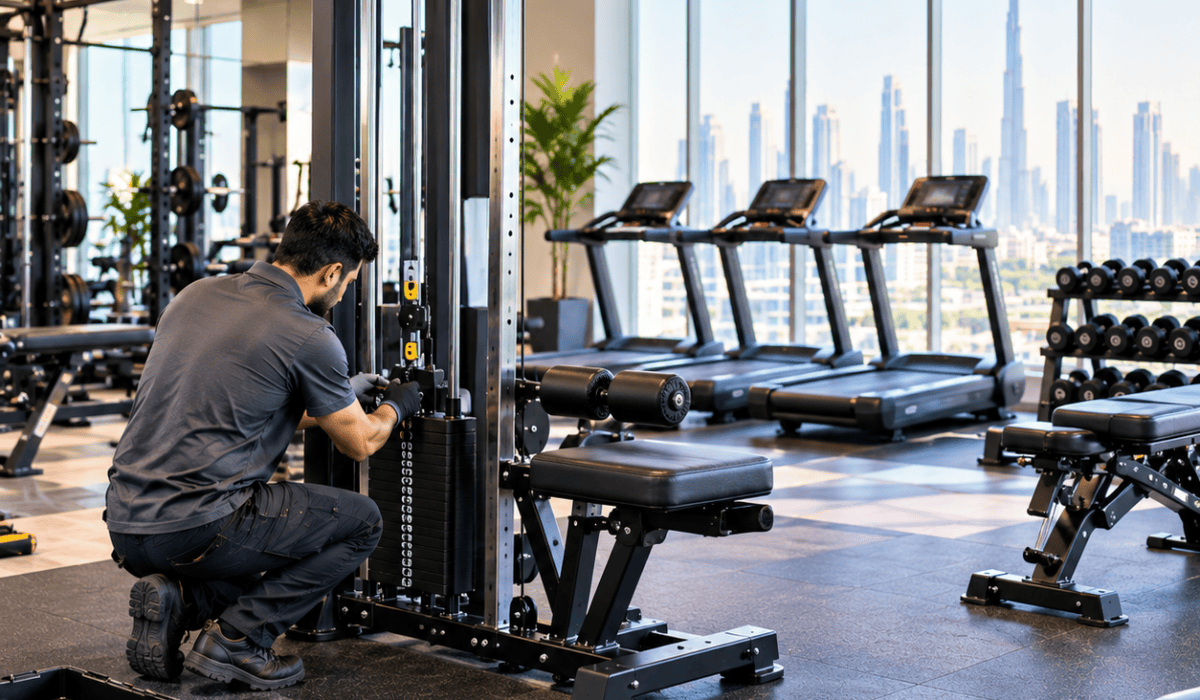
Gym Equipment Installation Service UAE: What Professional Setup Includes and Why It Matters
A gym equipment installation service covers the complete process of receiving, assembling, positioning, connecting, testing and handing over commercial fitness equipment in a gym environment. In the UAE market, where the majority of commercial gym equipment is imported, typically from the US or Europe, and where hotel and health club operators expect equipment to perform to international standards in a demanding climate the installation phase is as important as the equipment selection itself.
The Professional Gym Equipment Installation Service — 8 Steps for UAE Properties
Pre-Installation Site Survey
A professional UAE gym installer visits the site before delivery to verify: floor load capacity (commercial treadmills can exceed 300kg with user weight UAE high-rise floors require structural confirmation); ceiling clearance for cable machines and functional rigs; power outlet locations and circuit capacity; ventilation adequacy; and goods-lift dimensions to confirm equipment can enter the space. This survey prevents the most expensive installation problems discovering on delivery day that equipment cannot fit through the building’s goods entrance, or that floor loading is insufficient.
Delivery Coordination and Goods Receiving
Commercial gym equipment installation service arrive on pallets, typically in multiple shipments. A professional installation team coordinates delivery timing with the building’s loading dock or goods entrance, arranges specialist moving equipment (pallet trucks, pump trucks, trolleys rated for heavy strength machines), and manages the unpacking and inspection process checking every item against the packing list, documenting any transit damage before signing delivery acceptance, and reporting defects to the supplier before assembly begins. Damage discovered post-assembly is typically the buyer’s liability.
Floor Preparation and Protection
UAE gym floors typically polished concrete, hard tile or stone — require rubber protection underlay before any equipment is placed. The installer lays the correct specification of rubber flooring (typically 15–20mm vulcanised rubber tiles for free weight areas; 8–10mm rolled rubber for cardio zones) to OEM requirements, ensuring correct drainage gradient is maintained, joins are properly bonded, and underlay extends to the correct perimeter. In hotel gym refurbishments, temporary protection for existing finishes during installation is also part of the professional service.
Equipment Assembly to OEM Specification
Each piece of equipment is assembled by a certified technician following the manufacturer’s installation manual not a general-purpose handyperson. For complex equipment (multi-station cable systems, functional training rigs, commercial cardio with integrated digital displays), assembly requires specific torque settings for bolts, precise cable routing, and correct tensioning of belts and cables to OEM specifications. Assembly errors incorrect torque, reversed cable routing, misaligned belts are the primary cause of early equipment failure and personal injury claims in commercial gym settings.
Electrical and Network Connection
Powered cardio equipment (treadmills, cross-trainers, bikes with powered consoles) requires dedicated electrical connections not standard wall sockets shared with other loads. In UAE hotel gyms, this typically means a licensed UAE electrical contractor runs dedicated circuits to equipment positions before installation. Smart and connected gym equipment (Technogym Mywellness, Life Fitness connected platforms, Matrix Virtual Training) also requires network/Wi-Fi connection, screen mounting and software setup by a technician familiar with the specific platform. Voltage verification is mandatory for all imported equipment.
Safety Testing, Calibration and Commissioning
After assembly, every piece of equipment is tested before handover: treadmill belts are run and tracked; resistance calibrations are verified on bikes and ellipticals; emergency stop systems are tested; weight stacks are loaded and released through their full range; cable tensions are verified under load; and all safety labels and emergency information are confirmed in place. This commissioning stage generates a signed commissioning report a document that hotel FMs and gym operators should retain as evidence of compliant installation for insurance, warranty and regulatory purposes.
Layout Optimisation and Final Positioning
Equipment is positioned to the agreed gym layout drawing with verified clearances between machines (minimum 600mm between cardio units; minimum 1,000mm around free weight areas per international gym safety standards). In UAE hotel gyms assessed by DTCM, emergency egress clearances must not be obstructed by equipment placement. Final positioning also ensures treadmills are not placed directly adjacent to glass or in direct sunlight paths that would accelerate belt and motor degradation in UAE ambient temperatures.
Handover, Staff Training and Documentation
A professional UAE gym equipment installation service concludes with a formal handover: the client or facility manager signs off the commissioning report; gym staff are trained on correct equipment operation and daily maintenance procedures (wiping down, lubrication points, error code responses); maintenance manuals and warranty documentation are handed over in full; and the first preventive maintenance visit is scheduled. This handover documentation package is the foundation of the gym’s maintenance record required for warranty claims, insurance purposes and Dubai Municipality / DTCM compliance inspections.
UAE Gym Equipment Installation — What Makes the UAE Market Different
Gym Equipment Installation Requirements by Category — UAE Specification Guide
| EQUIPMENT CATEGORY | INSTALLATION COMPLEXITY | KEY UAE REQUIREMENT | PROFESSIONAL CERT NEEDED? |
|---|---|---|---|
| Commercial Treadmills | Medium | Dedicated 20A circuit per machine; belt tension set for UAE ambient heat; positioned away from direct sunlight; rubber underlay rated for 300kg+ point load | Yes — most brands require brand-certified installer for warranty |
| Ellipticals and Cross-Trainers | Medium | Stride calibration and resistance calibration to OEM spec; bearing lubrication with UAE climate-rated lubricant; level floor verified | Yes — Precor, Life Fitness, Technogym all require authorised installation |
| Spin / Cycle Studios | Medium-High | Bike positioning to 1.2m × 1.2m grid minimum; handlebar and seat torque settings; power console setup for connected platforms; floor anchor bolts for front feet | Brand-dependent — Peloton Commercial, Stages, Wattbike all have specific requirements |
| Selectorised Strength Machines | Medium | Weight stack assembly sequence critical; cable routing and tension to OEM spec; floor anchor for stability; side panel alignment | Yes — incorrect cable routing is a safety failure and warranty void |
| Functional Training Rigs | High | Structural ceiling fixings required (not optional in UAE — load calculations by structural engineer for existing buildings); cable system routing; accessory storage | Yes — structural fixings require certified installer; CE/UL documentation required |
| Free Weight Areas | Low-Medium | Rubber platform installation (20mm minimum); dumbbell rack level and stable; barbell storage rack anchored; mirror installation to safety glazing standard | Lower certification requirement — but rubber flooring bonding and mirror installation are specialist tasks |
| Smart / Connected Equipment | High | Wi-Fi network integration; app/platform activation; screen calibration; software update on first boot; data privacy compliance for UAE hotel guest data collection | Yes — Technogym, Life Fitness Connected require brand-certified activation technician |
| Outdoor / Pool-Deck Gym | High | Marine-grade or outdoor-rated equipment only; stainless steel fixings throughout; UV-rated cable coatings; drainage provision; DEWA-approved outdoor electrical connection | Yes — outdoor electrical connection requires DEWA-approved licensed contractor |
What does a gym equipment installation service include in UAE?
A professional gym equipment installation service in UAE includes: a pre-installation site survey (floor load, power supply, ceiling clearance, goods access); delivery coordination and damage inspection on receipt; professional assembly by OEM-certified or brand-authorised technicians following manufacturer installation manuals; electrical and network connection for powered and smart equipment; floor preparation and rubber flooring installation; safety testing and commissioning of every machine (belt tracking, resistance calibration, emergency stop verification, weight stack function); formal handover with signed commissioning report; staff training on correct operation and daily maintenance; and scheduling of the first preventive maintenance visit. The specific inclusions should be confirmed in writing before an installation contract is signed — scope varies significantly between providers in the UAE market, and a cheaper service that omits the site survey, commissioning report or staff training creates downstream cost and liability.
How long does gym equipment installation take in UAE
Installation timelines for UAE gym projects depend on the size and complexity of the facility. A small villa or apartment gym of 5–8 machines can typically be installed in 1–2 days by a 2-person team. A standard hotel gym of 15–25 cardio and strength machines, including rubber flooring installation and electrical connection, typically requires 3–5 days. A large health club or hotel fitness centre with 40+ machines, a functional training rig, spin studio and smart equipment integration should allow 7–10 working days. High-rise building access (goods-lift coordination, crane access) and UAE summer temperatures can add to timelines — plan for buffer days in summer installations. The site survey conducted before installation is the point at which an experienced UAE gym installer can give an accurate timeline estimate; any timeline quoted without a site survey should be treated as indicative only.
Cann gym equipment e relocated within a UAE hotel or facility
Yes — gym equipment relocation is a standard service offered by professional UAE gym installation companies, and it is strongly recommended over attempting to move commercial gym equipment with facilities staff. Commercial treadmills, multi-station cable systems and functional training rigs are heavy, complex items that require specialist moving equipment and, in the case of cable machines and strength equipment, disassembly and reassembly to avoid damage in transit. Relocation within the same building typically costs AED 500–1,200 per machine and includes disassembly, moving, reassembly and recommissioning. Building-to-building relocation (common when UAE hotel groups redeploy equipment between properties) costs more and requires transport logistics coordination. Any relocation that involves reassembly should be followed by a recommissioning test and a new commissioning report — particularly if the equipment will continue under its original warranty, as the original installation documentation covers the original location.