
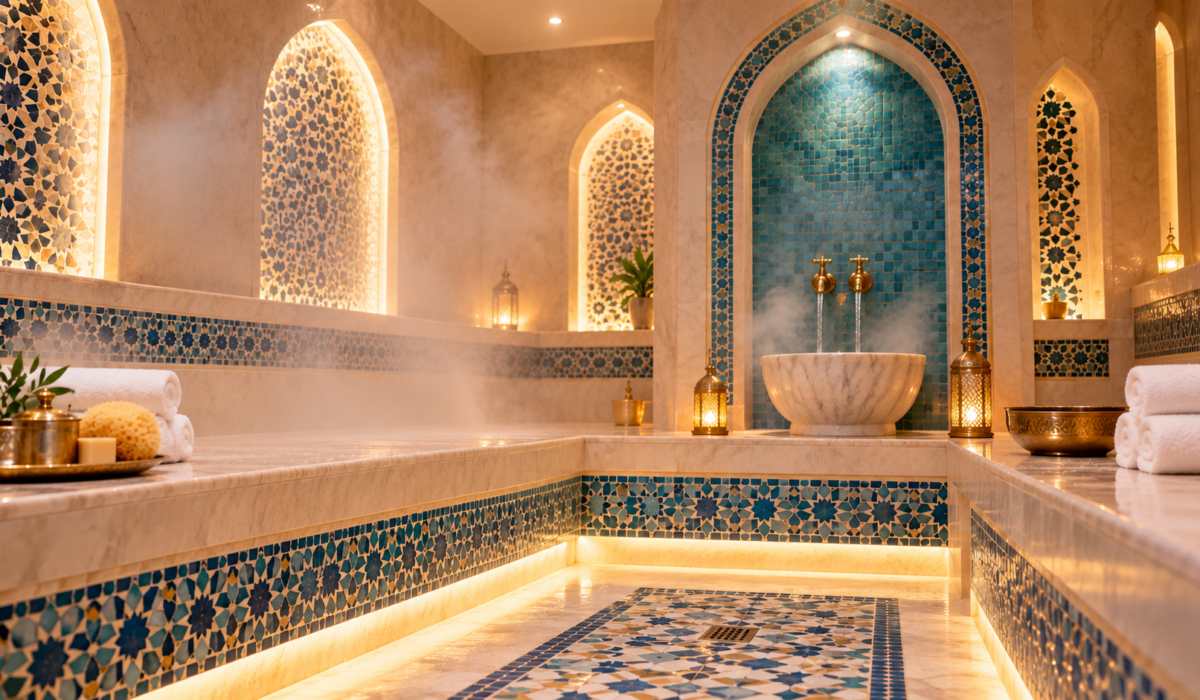
moroccan hammam kids UAE

Moroccan Hammam for Kids in UAE: Safe Design & Temperature Guide

Moroccan Hammam Kids UAE: Safe Design & Temperature Guide

A Moroccan hammam offers profound wellness, relaxation and cultural heritage — but for children in UAE family spas and residential villas, safe design and correct temperature management are essential. This guide covers everything parents, spa operators and facility designers need to know about creating and managing child-safe hammam spaces in the UAE.

A Moroccan hammam for kids in the UAE is safe when designed and operated to specific child-adapted standards. Safe hammam temperatures for children are: under 3 years — hammam not recommended; ages 3–6 — maximum 30°C room temperature, maximum 5 minutes, parent must be present; ages 7–12 — maximum 36°C, maximum 10–15 minutes, adult supervision required; ages 13–17 — maximum 40°C, same as adult guidance with parental consent. Child-safe hammam design features include non-slip mosaic or textured tile throughout, rounded edge finishes on all marble surfaces, handheld shower with temperature-limited mixing valve (maximum 38°C), lower bench seating at 30–35 cm height, and a clearly marked temperature zone so children remain in the cooler section. Dubai spa facilities operating child hammam sessions must comply with Dubai Municipality health and safety standards for family wellness areas.

Why Temperature Safety Is Critical for Children in a Moroccan Hammam

Children’s bodies respond to heat very differently from adults. A child’s thermoregulatory system — the body’s ability to regulate its internal temperature — is significantly less developed than an adult’s until approximately age 12–14. This creates specific risks in heated wellness environments like a Moroccan hammam that UAE parents and spa operators must understand before allowing children into any hammam space.

Children have a higher surface-area-to-body-mass ratio than adults, meaning they absorb heat from warm environments more rapidly. They also sweat less efficiently — particularly before puberty — which reduces their ability to cool down. In a Moroccan hammam environment where ambient temperature is elevated and steam or hot water may be present, these physiological differences mean children can reach dangerous core body temperatures faster than adults, and may not recognise or report the warning signs of heat stress before it becomes serious.

In the UAE, where ambient outdoor temperatures already reach 45°C+ in summer, children’s bodies are already working hard to maintain core temperature in everyday conditions. A hammam session adds an additional thermal load on top of already-elevated ambient conditions — making temperature discipline in UAE children’s hammam spaces even more critical than in temperate-climate countries.

Children Cannot Reliably Self-Report Overheating — Supervision Is Non-Negotiable

A critical safety principle for all child hammam use: children — particularly under age 10 — cannot reliably recognise and communicate early signs of heat stress. They may feel fine moments before becoming suddenly unwell with symptoms including dizziness, nausea, flushing and rapid heart rate. Adult supervision in the same space — not outside the room — is not optional in a child hammam session. A supervising adult who is also in the heat environment may themselves be impaired in judgment. The safest model is a designated supervising adult who enters only briefly to monitor and remains cooler than the child.

Safe Moroccan Hammam Temperatures for Children — Age-by-Age Guide

⛔ Under 3 Years
Not Recommended
Infants and toddlers under 3 should not enter any heated hammam room. Their thermoregulation is too immature. Warm bath in a private family setting is the appropriate alternative.
✓ Ages 3–6
Max 30°C
Room temperature only. No steam. Tepid water rinse maximum 35°C. Maximum 5 minutes. Parent in the room at all times. Pre-cool the room before entry.
✓ Ages 7–12
Max 36°C
Gentle warm room. Minimal steam only if tolerated well. Water rinse maximum 37°C. Maximum 10–15 minutes with breaks. Adult in or immediately adjacent to the room.
⚠ Ages 13–17
Max 40°C
Near adult parameters with parental consent and guidance. Avoid if any health condition, dehydration or recent illness. Full adult supervision recommended for first experiences.
🌡️

Install a Digital Room Thermometer Visible from Inside the Hammam

Child-safe hammam design in UAE family spas and residential villas should include a clearly visible digital temperature display mounted inside the hammam room, at child eye level (approximately 100–110 cm from floor). This allows the supervising adult — and older children — to monitor room temperature during the session and ensures temperature targets are maintained. A wall-mounted thermostat alone is insufficient: it controls the heating system but does not display the actual current room temperature that the child is experiencing. Temperature can drift upward during a session, especially in a small hammam room.

Age GroupMax Room TempMax Water TempMax Session TimeSteamSupervision
Under 3 yearsDo not enter——No—
3–6 years30°C max35°C max5 minutesNo steamParent in room
7–12 years36°C max37°C max10–15 minutesMinimal onlyAdult in/adjacent
13–17 years40°C max38°C max20–25 minutesLimitedAdult guidance + consent
18+ adults45–50°C standard40–42°C20–45 minutesYes

How Long Can Children Stay in a Moroccan Hammam? Time Limit Guide

Time limits are as important as temperature limits for child hammam safety. Core body temperature accumulates with exposure time — a room that seems comfortable in the first few minutes becomes physiologically stressful as the child’s body heat load increases. The following time limits apply to correctly-tempered child hammam sessions and should be treated as absolute maximums, not targets.

⏱️
Ages 3–6: Maximum 5 continuous minutes in any heated hammam room. Exit immediately if the child shows any discomfort, flushing or reluctance to stay. Allow full cool-down (minimum 15 minutes) before any re-entry.
⏱️
Ages 7–12: Maximum 10–15 minutes per session. Divide into two 5-minute segments with a 5-minute cool-down outside the room between them if multiple exposures are planned. Monitor skin colour (flushing), breathing rate and alertness throughout.
⏱️
Ages 13–17: Maximum 20–25 minutes per session, consistent with adult guidance for a first-time or irregular hammam user. Teens should exit and cool down if they experience any lightheadedness, rapid heartbeat or nausea.
💧
Hydration before entry is essential for all ages. Children should drink 200–300 ml of water before entering any hammam room. No fizzy drinks, juice or milk — water only. Have water available immediately outside the hammam for use during cool-down breaks.
🌡️
Children who are unwell, feverish, dehydrated or have eaten recently (within 1 hour) should not enter any heated hammam room. The hammam experience adds thermal stress that a body managing illness, digestive activity or dehydration cannot safely accommodate.

Child-Safe Moroccan Hammam Design Features for UAE Facilities : Moroccan Hammam Kids UAE

A family-use or child-accessible Moroccan hammam in a UAE villa, spa or hotel requires specific design adaptations beyond the standard adult hammam specification. These features protect children from the physical hazards — slip, fall, sharp edge, scalding water — that standard hammam design does not fully mitigate for younger users.

🪨

Non-Slip Flooring Throughout

All floor surfaces in a child-accessible hammam must be non-slip — R10 or R11 rated ceramic, textured mosaic, or hammam-specific anti-slip tile. Polished marble or smooth zellige tile that is standard in adult-only hammam design is a serious fall hazard for children. The non-slip treatment must extend to the hammam entrance transition area, where wet feet meet dry flooring. Recessed drainage channels are safer than raised drainage strips, which are a trip hazard for small feet.

R10/R11 ratingTextured mosaicRecessed drainage

🔧

Thermostatic Mixing Valve — 38°C Limit

All water outlets in a child-accessible hammam — the central kurna basin, handheld shower, and any wall-mounted outlets — must be fitted with a thermostatic mixing valve (TMV) set to a maximum of 38°C. This prevents any possibility of scalding from hot water, regardless of how taps are adjusted. In standard UAE hammam plumbing, hot water supply from the building can reach 60°C+ — a scalding temperature that can cause burns in seconds on a child’s more sensitive skin. A TMV is non-negotiable in any space children will use.

TMV mandatory38°C maximumAll water outlets

📐

Child-Height Bench and Seating

Standard hammam heated benches (the central slab or raised platform) are 45–55 cm high — a fall height that is significant for a small child. Child-safe hammam design includes a lower tier at 25–35 cm height, with a wide enough seat (minimum 45 cm depth) that a young child can sit with support and cannot roll off. The lower tier should be the cooler zone in a multi-temperature hammam layout, as heat rises and the lower bench is naturally several degrees cooler than the elevated main slab.

25–35 cm lower tier45 cm+ seat depthCooler zone positioning

✂️

Rounded Marble and Tile Edges

All marble surfaces, bench edges, wall recesses, step noses and transition strips in a child-accessible hammam must have fully rounded or bullnosed edges — no sharp 90-degree edges. In a standard adult hammam, sharp marble bench edges and step noses are common. In a wet, slippery environment with children who may fall or slip against these surfaces, a sharp edge can cause serious cuts or head injuries. Specify radius-finished edges (minimum 6 mm radius) on all horizontal marble surfaces in child zones.

6mm+ radius edgesBullnose stepsNo sharp marble corners

🔒

Temperature Zone Separation

A family hammam serving both adults and children should have a clearly defined cool zone — at 28–32°C — where children remain, separate from the central hot slab (45–50°C) used by adults. Physical separation using a low mosaic divider, a step threshold or a clearly marked tile pattern change indicates the boundary. Steam and water features in the child zone should be independently controlled from adult zones, so children’s temperature experience can be managed without affecting adult areas of the hammam.

28–32°C child zonePhysical boundary markerIndependent controls

🚿

Handheld Shower — Child Height

The primary water outlet for children in a hammam should be a handheld shower on a vertically adjustable rail, mounted so the lowest position is accessible by a 3-year-old at approximately 60–70 cm from floor. This allows the accompanying adult to control the shower direction and flow while the child is seated. Avoid overhead rain shower heads as the primary outlet in child areas — water directly onto the top of a small child’s head can be startling and increases heat load on the head and neck area.

Adjustable rail60–70 cm minimum heightAdult-controlled flow
Materials and Surfaces

Child-Safe Materials for UAE Moroccan Hammam Interiors

Textured Zellige (Non-Slip Specification)

Traditional Moroccan zellige can be specified in a matte or sand-textured finish that retains the cultural aesthetic while providing R10 slip resistance. Specify minimum 10×10 cm tile size for child zones — smaller mosaic pieces create more grout lines which aid grip but can collect bacteria if maintenance is inadequate.

Honed (Not Polished) Marble

Marble is appropriate in child hammam areas when specified as honed — a matte, slightly textured finish — rather than polished. Honed marble retains the luxury aesthetic at significantly better slip resistance. Seal honed marble every 6 months in high-humidity hammam environments to maintain its surface properties.

Micro-Textured Ceramic Tile

Micro-textured ceramic tile in Moroccan geometric patterns is a practical child-safe flooring option. It achieves R11 slip resistance, is easier to maintain than natural stone in high-use family facilities, and is available in traditional hammam colour palettes (white, turquoise, terracotta, cobalt blue).

Solid Brass Fittings (Not Chrome-Plated)

Water fittings in child hammam areas should be solid brass rather than chrome-plated. Chrome plating can develop sharp edges as it wears or chips in the high-humidity, high-use environment of a family hammam. Solid brass fittings are also safer if a child grabs or falls against them.

Teak or Anti-Slip Timber Accessories

Hammam wooden accessories — foot stools (tahta), bucket handles — should be teak or high-quality tropical hardwood that is sealed to prevent splinters. Avoid light-coloured timber that stains, or MDF-based products that can swell in steam environments and create sharp delamination hazards.

Anti-Bacterial Grout

Tile grout in child hammam areas should be specified as anti-bacterial, epoxy-based grout. Standard cement grout in a high-humidity environment used by children can harbour bacteria and mould. Epoxy grout is non-porous, chemical resistant and meets the hygiene standard expected in family wellness facilities in UAE.

Supervision Standards

Supervision Requirements for Children in UAE Hammam Facilities

👨‍👩‍👧

UAE Family Spa Hammams — Standard Supervision Requirements

In UAE licensed spa facilities, any hammam session involving children requires the presence of a responsible adult (parent or guardian aged 18+) who is physically present in or immediately outside the hammam room for the duration of the child’s session. Spa therapists cannot be designated as the responsible adult for a child unless they hold a recognised first aid qualification and the facility has a documented child supervision policy registered with Dubai Municipality or the relevant emirate authority. Most UAE hotel spas and standalone spa facilities require written parental consent before allowing any child under 16 into a heated hammam environment.

Signs a Child Should Leave the Hammam Immediately

🚨

Exit the Hammam and Seek Medical Attention Immediately If a Child Shows Any of These Signs

Do not wait to see if symptoms improve inside the hammam. Take the child to a cool area immediately, apply cool (not cold) water to the neck, wrists and forehead, and call for medical assistance. In UAE, call 998 (Dubai Ambulance) or 998 (Abu Dhabi) if symptoms include loss of consciousness, seizure, persistent vomiting or a skin colour that is bluish or very pale.

🔴
Sudden paleness or bluish skin tone — indicates inadequate circulation or shock. Exit immediately and lay the child flat in a cool area.
🔴
Loss of consciousness or unresponsiveness — call 998 immediately. Do not attempt to cool with ice-cold water.
🔴
Convulsion or seizure — febrile convulsions can be triggered by rapid temperature changes. Call 998. Move the child to a safe flat surface away from hard edges.
🟠
Vomiting — exit immediately. Nausea progressing to vomiting in a hammam environment indicates significant heat stress or vasovagal response.
🟠
Rapid or irregular breathing — panting or very fast breathing is a sign the child’s body is working hard to cool itself. Exit to a cool area immediately.
🟠
Intense red flushing of the face and neck — some flushing is normal but intense, rapid facial redness in a child indicates the body is overheating. Exit and cool down.
🟡
Dizziness, lightheadedness or unsteady walking — support the child and exit carefully. Lay them down in a cool area with legs slightly elevated.
🟡
Crying, distress or strong reluctance to stay — a child’s instinct to leave a hot environment should always be respected. Never keep a child in a hammam room against their expressed wish to leave.
🟡
Extreme lethargy or sudden sleepiness — unusual drowsiness in a warm environment can indicate heat exhaustion developing. Exit and cool down before it progresses.
UAE Regulatory Context

UAE Spa Regulations for Child Hammam and Wellness Services

Commercial spa and wellness facilities in the UAE offering hammam services to children operate within a regulatory framework that sets minimum standards for hygiene, safety and staffing. Facility operators should be familiar with the requirements of the relevant authority for their emirate and facility category:

AuthorityRelevant toChild Wellness Standards
Dubai Municipality (DM)All commercial spa and beauty facilities in DubaiSpa licensing conditions include hygiene and safety standards for facilities serving minors. Written parental consent is required for treatments on clients under 18 in licensed Dubai spas.
Dubai Health Authority (DHA)Medical wellness centres, physiotherapy-linked spa facilitiesDHA-regulated wellness facilities must document all treatments including hammam services for minors, with parental consent and practitioner qualification verification.
Department of Tourism (DTCM)Hotel spas and resort wellness facilities in DubaiHotel classification standards include wellness facility safety requirements. Child supervision and minimum age policies are part of hotel spa compliance audits.
Abu Dhabi DED / TAMMCommercial spa facilities in Abu Dhabi emirateAbu Dhabi spa licensing includes facility safety requirements. Child wellness services in Abu Dhabi spas should follow parental consent and supervision standards equivalent to Dubai DM requirements.
Private residential hammamsVilla and apartment hammam installationsNo formal licensing requirement but DEWA MEP registration applies to all electrical and plumbing installations including hammam heating and steam systems. Thermostatic mixing valves are required under UAE plumbing code for outlets in family areas.
📋

Child Hammam Policy — What UAE Spa Operators Should Document

UAE commercial spa facilities offering hammam services to children should maintain a documented child wellness policy covering: minimum age for hammam access (recommended: 3 years), parental consent form for all clients under 18, maximum temperature and session time parameters by age group, supervision requirements by age group, staff training records for child wellness safety, emergency procedures including local emergency contact numbers, and post-incident reporting protocol for DM or DHA notification. This documentation protects both the facility and the families it serves, and is increasingly reviewed as part of Dubai Municipality spa licence renewal inspections.

Leave A Comment

All fields marked with an asterisk (*) are required