How to Choose the Right Moroccan Hammam Builders
How to Choose the Right Moroccan bath Build Company
A Moroccan hammam is one of the most immersive, culture-rich wellness environments you can build — whether inside a private home, a luxury hotel, a resort, or a commercial spa. But the quality of your hammam experience is almost entirely determined by one decision made before a single tile is laid: choosing the right moroccan bath build company.
The wrong builder can mean cracked grout, inadequate waterproofing, a steam system that fails within twelve months, and a space that looks beautiful on a mood board but feels nothing like an
authentic hammam. The right moroccan hammam builders transform your vision into a living, breathing wellness sanctuary that lasts for decades.
This guide gives you everything you need to evaluate, shortlist, and appoint the best moroccan bath build company for your project in 2026 — with a detailed breakdown of what to look for, questions to ask, red flags to avoid, and a comparison of the different types of build specialists available globally.
What Does a Moroccan Bath Build Company Actually Do?
Before evaluating any moroccan hammam builders, it helps to understand the full scope of what a specialist build company delivers. This goes far beyond tiling and plumbing. A full-service moroccan bath build company typically provides:
- Concept design and 3D visualisation of the hammam space
- Structural consultation to ensure the room can support wet room loads and steam
- Waterproofing system specification and installation — the single most critical technical element
- Steam generator specification, supply, and installation
- Underfloor heating system design and installation
- Heated marble or stone slab (kessal bench) fabrication and fitting
- Authentic zellige tile sourcing from Morocco or equivalent premium materials
- Tadelakt or lime plaster application for walls and domes
- Plumbing, drainage design, and installation
- Lighting design tailored to hammam ambiance — often using star ceiling or LED systems
- Ventilation and air extraction to prevent condensation and mould
- Arched doorways, domed ceiling construction, and decorative ironwork
- Project management from design to handover
- Post-completion commissioning and maintenance guidance
Not every moroccan hammam builders company will offer all of these services. Understanding which are included — and which require additional subcontractors — is essential when comparing quotes.
Why Specialist Moroccan Hammam Builders Matter
A hammam is not a standard wet room. It is not a sauna. It is not a steam shower. It is a purpose-built environment that combines structural engineering, authentic craftsmanship, and a deep understanding of Moroccan design tradition. Here is why hiring a generalist builder almost always ends badly:
Technical Complexity
Moroccan hammam environments expose materials to continuous humidity, temperature cycling between 40°C and 55°C, and direct water contact. The waterproofing system must be tanked to a standard that prevents water ingress into the structure — a requirement that standard builders routinely underestimate. A specialist moroccan bath build company will specify tanking membranes, bonding slurries, and grout systems that are validated for steam environments, not simply bathroom use.
Material Sourcing
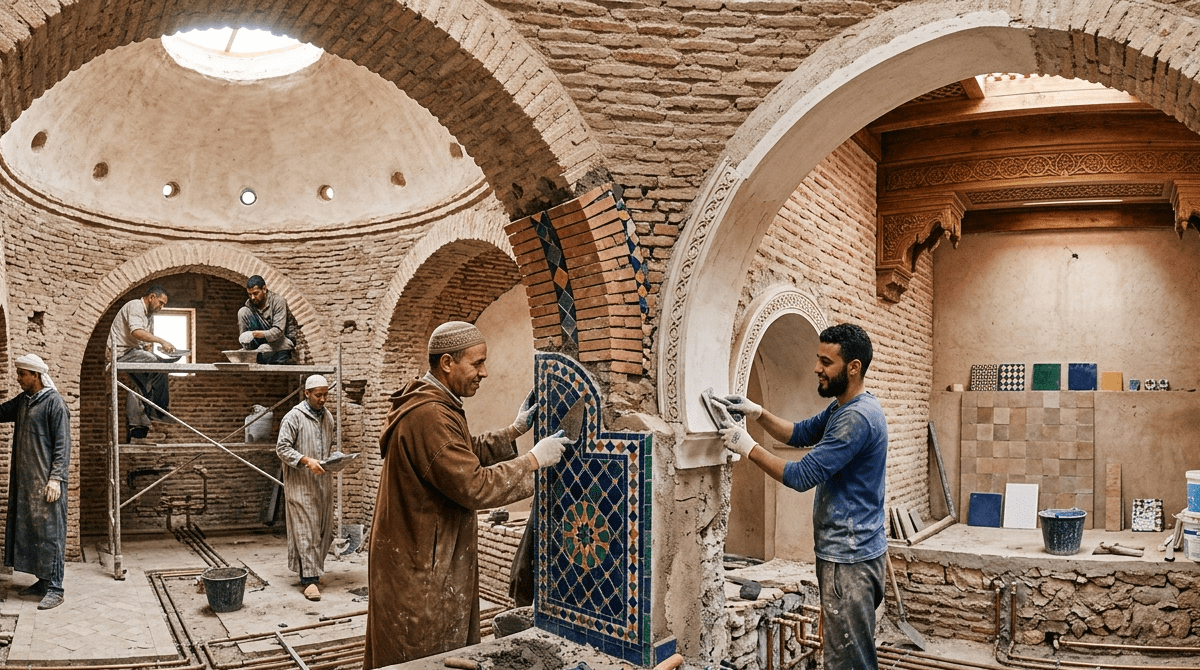
Authentic hammams use zellige tiles hand-cut by artisans (zelliges) in Morocco, tadelakt (a burnished lime plaster that is naturally waterproof), and natural stone slabs — often marble or travertine from North Africa. These materials require specialist knowledge to source ethically, import correctly, and install properly. A generalist tiler working with zellige for the first time will produce uneven, misaligned results that immediately look amateurish.
Steam System Integration
The steam generator must be correctly sized for the room volume, integrated with the ventilation system, and controlled to maintain safe temperatures. Undersized systems produce inadequate steam; oversized systems create dangerous overheating risks and accelerate material degradation. Moroccan hammam builders who have commissioned dozens of systems understand this balance intimately.
Cultural Authenticity
Beyond the technical, a great moroccan bath build company understands the spatial logic and cultural rhythm of a real hammam — the progression through warm, hot, and cool zones; the placement of the heated slab at the centre of the hot room; the relationship between water basins, steam nozzle positioning, and user flow. This knowledge only comes from deep immersion in the craft, not from watching a YouTube tutorial.
Types of Moroccan Bath Build Companies: Which Is Right for You?
The global market for hammam construction has grown significantly, and there are now several distinct categories of moroccan hammam builders to choose from:
1. Full-Service Bespoke Hammam Specialists
These companies focus exclusively or primarily on hammam design and construction. They handle everything from concept to commissioning and typically employ in-house designers, waterproofing experts, tadelakt artisans, zellige tilers, and project managers. They are the premium option and command higher fees, but they deliver the most cohesive, authentic, and technically sound results. Best for: luxury residential hammams, five-star hotel spa installations, flagship commercial spa builds.
2. Luxury Wet Room and Spa Contractors
These contractors build high-end bathrooms, spa wet rooms, and steam facilities. They can build a hammam-adjacent space that looks the part but may lack the depth of cultural knowledge and specialist material sourcing that a true specialist offers. They are often more
accessible in pricing. Best for: mid-range residential projects where budget is a consideration but quality remains a priority.
3. Moroccan Artisan Cooperatives
Some clients — particularly in the UAE, UK, and France — contract directly with Moroccan artisan cooperatives for zellige work, tadelakt finishing, and carved plasterwork (gypsum stucco / jbss). These cooperatives can produce breathtaking results but require a separate contractor to manage structural, waterproofing, steam, and mechanical elements. Best for: clients with an existing project manager or contractor who want authentic Moroccan craft for the decorative elements.
4. Interior Design-Led Build Partners
Some interior design firms offer a design-and-build service that includes hammams as part of a wider residential or hospitality project. The design quality is often excellent; the technical build quality depends heavily on which subcontractors they appoint. Best for: whole-property renovation projects where the hammam is one element of a broader interior scheme.
10 Things to Look for in the Best Moroccan Bath Build Company
When evaluating any moroccan bath build company, use this framework to assess capability and credibility:
1. A Portfolio of Completed Hammam Projects
Any serious moroccan hammam builders will have a substantial portfolio of completed projects — not mood boards or renders, but installed and commissioned hammams with photography and, ideally, video walkthroughs. Ask to visit a completed project in person wherever possible.
2. Specialist Waterproofing Credentials
Ask specifically which waterproofing system they use and what the manufacturer’s guarantee is. Reputable systems include Schluter KERDI, Mapei Mapelastic, or equivalent tanked membrane systems designed for steam environments. If they cannot name the system, walk away.
3. Steam System Partnerships
Leading moroccan hammam builders maintain partnerships with professional steam generator manufacturers — brands such as Tylo, Mr Steam, Steamist, or Helo. They should be able to specify the correct generator for your room volume and provide a commissioning report at handover.
4. In-House or Verified Tadelakt and Zellige Specialists
Ask whether their tadelakt artisans and zellige tilers are employed directly or subcontracted. If subcontracted, ask to see that subcontractor’s portfolio specifically — not the parent company’s general portfolio. Tadelakt application is a multi-day skill that takes years to master; zellige cutting and laying on curved surfaces even more so.
5. Structural and Waterproofing Guarantees
A credible moroccan bath build company will provide a written structural waterproofing guarantee — typically a minimum of ten years on the tanking system. If they do not offer a written guarantee, this is a significant red flag.
6. Full Project Management Capability
Building a hammam within an existing property involves coordinating multiple trades: structural, plumbing, electrical, mechanical (steam and ventilation), tiling, plastering, and joinery. A full-service build company will provide a dedicated project manager who coordinates all of these trades and holds a single point of accountability. If they expect you to manage the trades yourself, you are effectively acting as the contractor — with all the associated risk.
7. Client References and Testimonials
Always ask for at least three client references from comparable projects — similar budget, similar project type. Speak to those clients directly and ask specifically about: timeline adherence, budget management, communication quality, technical performance of the steam system, and any post-completion issues.
8. Detailed and Transparent Quotations
A professional moroccan bath build company will provide a line-by-line quotation that clearly separates labour, materials, steam equipment, tiling, waterproofing, plumbing, electrical, and project management costs. Vague lump-sum quotations make it impossible to compare like for like and often mask hidden costs that emerge mid-project.
9. Material Provenance and Sustainability
In 2026, clients — particularly in the luxury segment — increasingly ask where materials originate and how they are sourced. A credible moroccan hammam builders company can tell you which cooperative their zellige comes from, whether their argan products are certified, and how they manage waste and material transport. This is increasingly an E-E-A-T signal in the wellness sector.
10. Aftercare and Maintenance Support
A hammam is a living, operational environment. Steam systems require annual servicing; tadelakt surfaces require periodic conditioning; drainage requires regular maintenance. The best moroccan bath build companies offer a post-completion maintenance programme or at minimum provide a detailed owner’s manual and connect you with local service providers.
Regional Considerations: Finding the Best Moroccan Hammam Builders Near You
UAE & Middle East
The UAE — particularly Dubai and Abu Dhabi — has one of the most sophisticated markets for private hammam builds globally, driven by demand from luxury residential developments, seven-star hotel projects, and high-net-worth homeowners. The best moroccan bath build companies operating in the UAE maintain relationships with Marrakech and Fez artisan cooperatives for authentic material supply, while adhering to UAE building codes for waterproofing, electrical, and mechanical installations. When evaluating builders in this region, confirm that they hold a valid trade licence from the relevant emirate authority (DED in Dubai, DoM in Abu Dhabi) and that their steam systems comply with UAE electrical standards.
The Build Process: What to Expect Step by Step
Understanding the construction sequence helps you manage expectations and hold your moroccan bath build company accountable at each stage:
- Initial consultation and brief — discussing vision, budget, site constraints, and timeline
- Site survey and structural assessment — confirming load capacity, drainage, waterproofing requirements
- Concept design and 3D visualisation — reviewing layout, material palette, steam zone configuration
- Design sign-off and contract execution — agreeing specifications, programme, and payment schedule
- Strip-out and structural preparation — removing existing finishes, preparing substrate
- First-fix plumbing and electrical — supply lines, drainage, electrical conduit, steam pipework
Structural waterproofing (tanking) — application and curing of tanking membrane syste
- Underfloor heating installation — electric or hydronic heating mats
- Zellige tile laying and grouting — specialist tilers working from centre outward
- Heated marble slab fabrication and installation — kessal bench positioning and fixing
- Tadelakt wall and ceiling application — multi-day process of application, burnishing, and waxing
- Steam generator installation and commissioning — including pressure test and safety check
- Ventilation, lighting, and final electrical connections
- Snagging inspection and client sign-off
- Handover, owner’s manual, and maintenance briefing
How do I find the best moroccan bath build company near me?
Start by searching for specialist moroccan hammam builders (not general bathroom contractors) and asking to see a portfolio of completed hammam projects. Request site visits to completed projects, ask for client references, and obtain at least three itemised quotations. Trade associations, luxury interior designers, and hotel development networks are often the best sources of referrals for reputable moroccan bath build companies.
How long does it take to build a Moroccan hammam?
A residential hammam typically takes 6 to 14 weeks from start to completion, depending on the complexity of the build, availability of specialist artisans, and material lead times for imported zellige tiles and tadelakt materials. Commercial and hotel hammam builds typically take 12 to 26 weeks. Always build contingency into your programme for material sourcing delays.
What is the most important technical requirement in a hammam build?
Waterproofing is the single most critical technical element of any hammam build. A steam-rated tanking system must be applied correctly to the full floor and wall surface before any tiling or plastering begins. A failed waterproofing system leads to structural water damage, mould, tile delamination, and complete strip-out remediation that typically costs more than the original build. Always confirm the waterproofing specification and guarantee with your moroccan hammam builders before signing a contract.
What materials are used in an authentic Moroccan hammam build?
Authentic materials used by specialist moroccan hammam builders include zellige (hand-cut glazed terracotta tiles) for floors and lower walls, tadelakt (burnished lime plaster) for upper
walls and ceilings, natural marble or travertine for heated slabs and basins, carved gypsum stucco (jbss) for decorative panels and archways, and forged iron for door fixtures and lanterns. Heating is provided by underfloor heating and a steam generator, with wooden or marble benches completing the interior.
Should I choose a local builder or a specialist moroccan bath build company?
For a project as technically and culturally specific as a Moroccan hammam, a specialist moroccan bath build company will almost always deliver a superior result compared to a local general contractor — even at a higher cost. The technical failures that most commonly occur in hammam builds (waterproofing failure, incorrect steam system sizing, misapplied tadelakt) are almost entirely avoidable with a builder who specialises in this environment. The additional investment in a specialist is consistently recouped in longevity, quality, and the authentic experience the space delivers.
completing the interior.
Conclusion: Make the Right Choice Before the First Tile Is Laid
A Moroccan hammam is one of the most significant wellness investments you will ever make in a property. Done well, it adds extraordinary value — financially, experientially, and culturally — to any home, hotel, or spa. Done poorly, it becomes a costly, frustrating remediation project.
The single most important decision in your hammam project is choosing the right moroccan bath build company. Use the framework in this guide: check the portfolio, verify the waterproofing specification, speak to previous clients, scrutinise the quotation, and confirm the artisan credentials. The best moroccan hammam builders will welcome every one of these questions — because they know their work can stand up to scrutiny.
Your hammam should still be performing beautifully in thirty years. That begins with the company you choose today.