How to Remove Stubborn Limescale from Steam Room Tiles in UAE Properties
If you own or manage a steam room in the UAE — whether inside a luxury villa, hotel spa, residential building, or commercial gym — you will know exactly what limescale looks like. That thick, white, chalky crust slowly spreading across your tiles, grout lines, glass panels, and steam nozzles. It looks unsightly, it’s stubbornly difficult to remove, and left untreated it causes real, costly damage to your steam room surfaces and equipment.
The UAE sits at the heart of one of the hardest water regions in the world. Dubai’s tap water contains extremely high levels of dissolved calcium and magnesium minerals — and when that water is heated to the temperatures required for steam therapy, mineral deposits are left behind at an accelerated rate. The result: limescale builds up faster in UAE steam rooms than almost anywhere else on the planet.
The good news? With the right knowledge, the right products, and a consistent maintenance routine, limescale in your steam room is entirely manageable. This guide walks you through everything: what causes it, how to remove it safely from different tile types, what to avoid, and how to prevent it from coming back.
Why Limescale Builds Up So Fast in UAE Steam Rooms
Understanding the cause is the first step to solving the problem. Limescale is calcium carbonate — a mineral compound that precipitates out of hard water when it is heated and evaporated. The UAE’s desalinated tap water, despite going through treatment, retains a very high mineral content. When this water enters your steam generator and is heated to 100°C+, the minerals do not evaporate — they get deposited on every surface the steam touches.
In a typical steam room session, hundreds of litres of steam pass through the space. That means hundreds of litres of mineral-laden water vapour condensing on your tiles, glass, and nozzles every single day. In a busy hotel spa or residential building, this happens continuously.
The specific conditions that accelerate limescale in the UAE:
- Extremely hard water — TDS (Total Dissolved Solids) levels in Dubai often exceed 400–600 ppm
- High steam temperatures — mineral deposition increases exponentially as temperature rises
- Daily use — most commercial steam rooms operate 8–16 hours per day
- Inadequate ventilation — condensation lingers longer, increasing mineral deposit contact time
- Irregular cleaning — once limescale hardens, it bonds chemically with the tile surface
Before You Start: Know Your Tile Type
This is the most important step many people skip — and the most common cause of tile damage during limescale removal. Different tile materials have very different tolerances for acidic descaling products. Using the wrong cleaner can etch, stain, or permanently dull your tiles.
Tile Type | Acid Descaler Safe? | Recommended Product | Notes |
Ceramic / Porcelain | ✓ Yes (diluted) | Citric acid, white vinegar, mild phosphoric acid | Most common in UAE steam rooms — generally safe |
Natural Stone (Marble, Travertine) | ✗ Never | pH-neutral stone cleaner only | Acid will etch and permanently dull the surface |
Limestone / Calcite-Based | ✗ Never | pH-neutral cleaner + professional advice | Limestone IS calcium carbonate — acid will dissolve it |
Zellige / Moroccan Tile | ⚠️ Caution | Citric acid very diluted — test first | Handmade tiles vary — always patch test first |
Glass / Shower Panels | ✓ Yes | White vinegar or glass-safe descaler | Safe but requires soft cloth — never abrasive |
Grout Lines | ✓ Mild only | Baking soda paste or citric acid spray | Avoid strong acid — will erode grout over time |
What You Will Need — Tools & Products
Gather everything before you start. Having the right tools makes the job significantly faster and protects your tiles from unnecessary scrubbing damage.
Cleaning Agents (choose based on your tile type):
- White vinegar — mild, safe for ceramic/porcelain, readily available across UAE supermarkets
- Citric acid powder — stronger than vinegar, dilute 1:10 with water, excellent for moderate limescale
- Commercial descaler spray — look for products labelled ‘bathroom descaler’ or ‘limescale remover’ at Ace Hardware, LuLu Hypermarket or Carrefour UAE
- pH-neutral stone cleaner — essential if your steam room has marble or natural stone tiles (never use acid)
- Baking soda — useful for grout lines and as a gentle abrasive paste
Tools:
- Soft microfibre cloths — x3 minimum
- Soft-bristle grout brush — essential for grout lines (do not use metal bristles)
- Non-scratch scrubbing pad — for moderate buildup on ceramic/porcelain only
- Spray bottle — for applying diluted solutions evenly
- Plastic scraper — for thick crust deposits (never metal on tiles)
- Rubber gloves and eye protection — mandatory when using any acidic solution
- Bucket with warm water — for rinsing
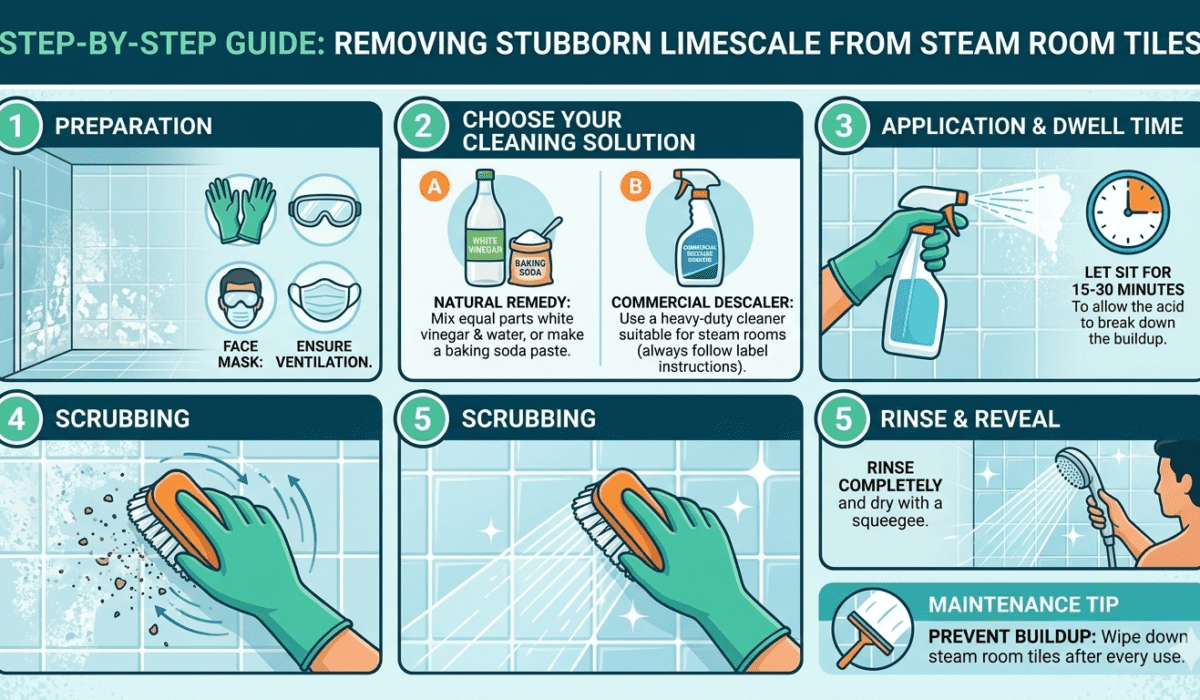
Step-by-Step: How to Remove Limescale from Steam Room Tiles
Follow these steps in order. Do not rush the dwell time — allowing the cleaning agent to work chemically reduces the need for aggressive scrubbing, which is the primary cause of tile scratching.
01 | Ventilate and Cool the Room Never clean a hot steam room. Allow the room to cool completely to room temperature and open the door for at least 30 minutes before starting. Working in a hot, humid environment is both dangerous and less effective — heat causes cleaning solutions to evaporate before they can work. |
02 | Rinse the Tiles with Warm Water Before applying any cleaning product, rinse all tile surfaces with warm water. This removes loose residue, soap scum and surface dust, and opens the mineral deposits slightly by rehydrating them — making the descaler more effective. |
03 | Apply Your Descaling Solution Mix your chosen descaler according to the instructions (or use the dilution ratios below) and apply generously to affected tile areas using a spray bottle: • Mild limescale (hazy white film): 50% white vinegar + 50% warm water • Moderate limescale (visible crust): citric acid solution — 1 tablespoon per 500ml warm water • Heavy limescale (thick, layered deposit): commercial descaler spray at full strength (ceramic/porcelain only) |
04 | Allow to Dwell — Do Not Skip This Step This is the step most people rush — and it is the most important. Dwell time allows the acid to chemically dissolve the calcium carbonate bond. Scrubbing too early just spreads the limescale around. • Mild solution (vinegar): minimum 10–15 minutes • Citric acid solution: 20–30 minutes • Commercial descaler: follow manufacturer’s instructions — typically 5–20 minutes |
05 | Scrub Gently with the Right Tool After dwell time, scrub the treated areas using a soft microfibre cloth or non-scratch pad (ceramic/porcelain only). Work in circular motions. For grout lines, use the soft-bristle brush. For stubborn deposits, use the plastic scraper at a very low angle — never force it vertically into the tile surface. |
06 | Rinse Thoroughly — Twice Rinse all treated surfaces with clean warm water — rinse twice. Acid residue left on tiles, even diluted, can slowly etch the surface over time. Pay particular attention to grout lines where solution can pool. |
07 | Dry Completely Dry all surfaces with a clean microfibre cloth. Do not leave the steam room damp after cleaning — moisture sitting on grout and tile edges accelerates future mineral deposition and can encourage mould growth in the grout. |
08 | Treat the Steam Nozzles and Generator Inlet Limescale inside and around the steam nozzles is one of the main causes of reduced steam flow and generator damage. After cleaning the tiles, wipe the nozzle heads with a vinegar-soaked cloth and allow to soak for 10 minutes before rinsing. For the steam generator itself, consult the manufacturer’s descaling procedure. |
Dealing with Natural Stone and Marble Tiles
If your steam room features marble, travertine, limestone or any natural stone tile — stop. Do not use any of the acid-based solutions described above. Acid and natural stone are chemically incompatible. Even diluted white vinegar will etch the polished surface of marble, leaving a permanently dull, rough patch that cannot be buffed out without professional regrinding.
Safe method for natural stone steam room tiles:
Preventing Limescale: A UAE-Specific Maintenance Routine
The most effective treatment for limescale is preventing it from building up in the first place. Given the UAE’s uniquely hard water conditions, a consistent routine is essential for any property — residential or commercial.
Recommended Maintenance Schedule:
FREQUENCY | TASK |
After every use | Wipe all tile surfaces and glass with a dry microfibre cloth to remove condensation before minerals dry |
Weekly | Light spray of diluted white vinegar solution across tiles and nozzles — rinse after 5 minutes |
Monthly | Full descale treatment using citric acid solution — all tiles, grout, nozzles and glass panels |
Every 3–6 months | Professional deep clean and steam generator descale — essential for commercial properties |
Annually | Re-seal grout lines and check tile adhesion — replace any cracked or lifting tiles immediately |
Additional Prevention Measures:
- Install a water softener on the steam generator feed line — this is the single most effective long-term solution and is strongly recommended for commercial UAE properties
- Use demineralised or RO (reverse osmosis) water in your steam generator where the manufacturer permits
- Ensure the steam room has adequate ventilation to prevent extended condensation contact with surfaces
- Run the exhaust fan for 10–15 minutes after every session to dry the room
- Apply a tile and grout sealant annually — a sealed surface repels minerals and dramatically slows buildup
When to Call a Professional
DIY limescale removal works well for regular maintenance and mild to moderate buildup. However, there are situations where professional intervention is the right — and often more cost-effective — choice.
- Stage 3 limescale (deeply pitted tiles, permanent white staining) — professional acid washing or tile replacement may be the only option
- Natural stone tiles — always use a professional for anything beyond surface-level cleaning
- Commercial properties — hotels, spas, gyms and residential towers should schedule professional descaling every 3–6 months to protect their investment and meet hygiene standards
- Steam generator descaling — most manufacturers specify professional descaling annually; DIY descaling incorrectly can void your warranty
- Recurring grout damage — if grout is consistently crumbling, cracking or discolouring after cleaning, there is an underlying problem requiring a professional assessment
- After any flooding or water ingress event — always have the steam room professionally assessed before returning it to service
Looking for a Professional Steam Room Maintenance Service in the UAE?• We provide full steam room maintenance, descaling, tile restoration and steam generator servicing across Dubai, Abu Dhabi and the wider UAE • All work is carried out by trained technicians experienced in all tile types — ceramic, porcelain, marble, zellige and natural stone • Contact us for a free site assessment and maintenance quote |
Limescale in UAE steam rooms is not a problem you can ignore — the UAE’s exceptionally hard water means mineral deposits form faster and bond more aggressively to tile surfaces than in most other countries. The key to keeping your steam room in peak condition is a consistent, routine approach: wipe after every use, do a light weekly vinegar treatment, and schedule a proper deep descale every month.
Know your tile type before you reach for any cleaning product. A single inappropriate acid application on marble or natural stone can cause permanent damage worth thousands of dirhams to repair. When in doubt — patch test first, or call a professional.
With the right routine and the right products, your steam room tiles can stay clean, hygienic and mineral-free all year round — regardless of the UAE’s notoriously hard water conditions.
Add Your Heading Text Here
How often should I clean limescale from steam room tiles in Dubai?
In Dubai and across the UAE, where tap water has a very high mineral content, you should do a light cleaning of steam room tiles at minimum once per week using a diluted white vinegar or citric acid spray. A thorough descaling treatment should be carried out monthly. For commercial properties — spas, hotels, gyms and residential buildings — professional descaling every 3 to 6 months is strongly recommended to prevent long-term tile and grout damage.
Can I use vinegar to remove limescale from steam room tiles in the UAE?
Yes — white vinegar is a safe and effective mild descaler for ceramic and porcelain steam room tiles and is readily available across UAE supermarkets. Mix it in equal parts with warm water, spray onto affected tiles, leave for 10 to 15 minutes, then wipe clean and rinse thoroughly. However, never use vinegar on marble, travertine, limestone or any natural stone tiles — the acetic acid will etch and permanently dull the stone surface.
What is the best limescale remover for steam room tiles in UAE properties?
For ceramic and porcelain tiles, citric acid (diluted 1 tablespoon per 500ml of warm water) is one of the most effective and tile-safe descalers available in the UAE. It is stronger than vinegar but gentler than commercial acid-based products. Commercial bathroom descaler sprays from Ace Hardware, LuLu or Carrefour also work well on ceramic/porcelain. For natural stone tiles — marble, travertine or limestone — only use a pH-neutral, stone-safe cleaner. Using acid products on natural stone will cause irreversible damage.
Why does limescale build up so quickly in UAE steam rooms?
The UAE has some of the hardest tap water in the world, with Total Dissolved Solids (TDS) levels frequently exceeding 400 to 600 ppm in cities like Dubai and Abu Dhabi. When this mineral-rich water is heated inside a steam generator and converted to steam, the dissolved calcium and magnesium cannot evaporate — they are deposited directly onto every surface the steam touches. The combination of extremely hard water, high temperatures and daily use means limescale forms and hardens much faster in UAE steam rooms than in most other countries.
How do I prevent limescale in my steam room in the UAE?
The most effective long-term prevention measure is installing a water softener or using reverse osmosis (RO) water for your steam generator feed — this reduces the mineral content of the water before it ever enters the system. On a daily basis, wipe down all tile surfaces with a dry microfibre cloth after every session to remove condensation before the minerals dry and bond. Apply a penetrating tile and grout sealant annually to create a surface that repels mineral adhesion. A weekly light vinegar spray and monthly citric acid descale will keep buildup manageable and protect your tiles from long-term staining.